
GEM Engserv Pvt. Ltd is an ISO 9001:2015 certified organization, certified by TUV India in accreditation with National Accreditation Board for Certification Bodies (NABCB).

In high-rise construction, concrete pours happen every day—and most of them go as planned. But occasionally, a site experience forces us to pause, investigate, and learn.
High-strength concrete needs high-discipline execution.
This article shares one such real site incident involving M40 free-flow concrete at a 30th-level slab, where concrete remained plastic even after three days.
Sometime in December 2025, M40 free-flow concrete was cast for a slab for the 30th floor. The pour included slab, beams and shear walls. One critical detail: the shear wall height exceeded 4.0 metres, making early strength development and formwork stability even more important.
The pour went smoothly. All transit mixers underwent quality checks before acceptance at the site. Workability of concrete was good. Nothing appeared unusual during casting.
However, what followed raised serious concerns.
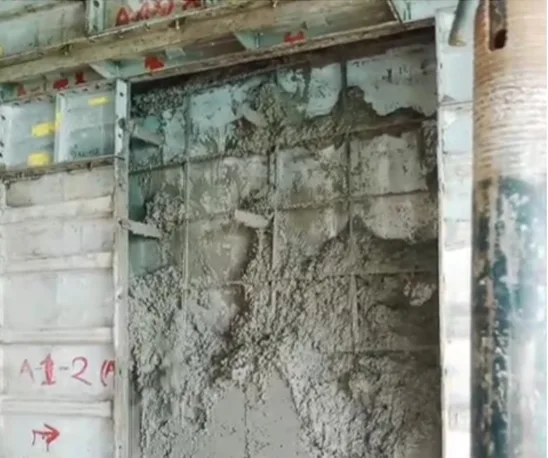
On the day after the pour, as part of routine checks, one shuttering plate was removed to assess surface hardness of the concrete. What the team saw was unexpected:
Recognizing the risk, the site team immediately stopped all further de-shuttering and decided to retain the entire formwork system. This early decision proved crucial.
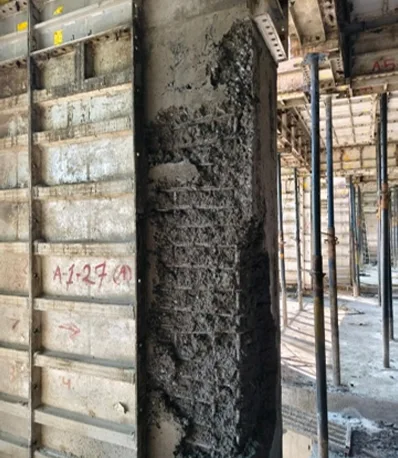
Three days after the pour, after allowing additional curing time, shuttering plates were again partially removed. Unfortunately, the situation had not improved.
Even after nearly 72 hours, the concrete remained slushy and deformable and showed sagging at beam–wall junctions. For concrete of any grade, this behaviour is highly abnormal.
What should normally happen
As per IS 456:2000, structural concrete should:
Under normal conditions, concrete reaches initial set within the setting time of concrete which varies from 6–10 hours. Prolonged plasticity may impact strength, durability, and structural safety—especially in tall vertical elements.
So, what went wrong?
While detailed investigations were initiated, the likely contributors included:
As highlighted in IS 9103, admixtures must be used within prescribed dosage limits and verified for compatibility with cement. If the mix is not robust and the cement-admixture combination lacks compatibility, even small deviations can have large consequences.
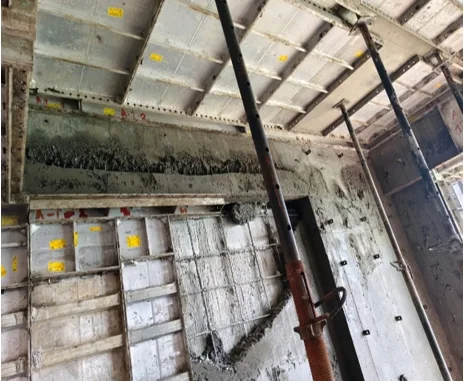
On further investigation, it was identified that the last four transit mixers (TM) supplying the affected concrete were dispatched from a different batching plant of same RMC Vendor. The vendor accepted that the affected batches had received excess dosage of the retarder admixture. This could not be detected by the QC checks at the pouring point. Monitoring every batch at the RMC plant may have detected this, but this is considered impractical and prohibitively expensive. Subsequent to this discovery, the said plant has been disqualified for further supply of concrete to this project, pending detailed technical and quality audit.
This finding confirmed that the defective concrete originated from a production-side deviation, not from site handling
Why this matters?
In this case, the risks were real:
For a 30th-level slab, these risks are not theoretical—they directly affect safety, time, and cost.
What the team did right?
Despite the technical issue, the site response deserves recognition:
Sometimes, good decisions under pressure prevent bigger failures.
Engineering recommendation
Based on the abnormal setting behaviour and high structural risk, the project team recommended complete dismantling and removal of the affected concrete in the shear wall and beam zones where delayed setting was observed. Partial repairs or surface treatments were not considered acceptable because the internal microstructure of such concrete remains compromised.
To verify the integrity of surrounding concrete, it was further recommended to conduct Ultrasonic Pulse Velocity (UPV) testing in the adjacent zones, extending at least 1.5 metres beyond the visibly affected area. This would help in:
Only concrete zones demonstrating acceptable UPV values and uniform wave transmission were to be retained.
Key learnings we’re taking forward
This incident reinforced some critical truths:
Modern concrete technology gives us incredible capabilities—but it also demands respect for the science behind it. This experience reminded us that concrete doesn’t fail suddenly; it gives warnings. Our responsibility is to notice them, act early, and learn together.
That’s how safer structures are built—one lesson at a time.