
GEM Engserv Pvt. Ltd is an ISO 9001:2015 certified organization, certified by TUV India in accreditation with National Accreditation Board for Certification Bodies (NABCB).
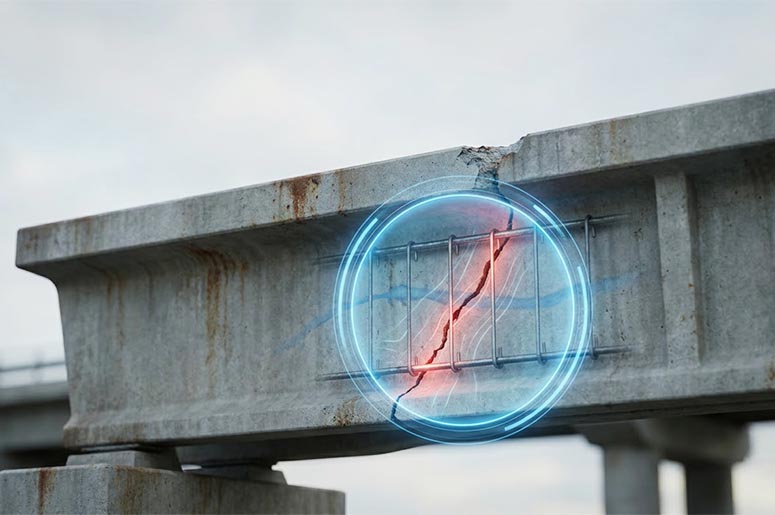
Forensic and diagnostic investigations of bridges and buildings are often approached as if they were primarily exercises in inspection and testing: observe the distress, conduct a few non-destructive tests, collect samples, obtain laboratory results and prepare a report. This approach can generate a large amount of data, but data alone does not constitute a diagnosis.
The real challenge in forensic engineering is to establish the chain from symptom to mechanism to cause to consequence. Cracks, corrosion, leakage, deflection, spalling, settlement or deterioration are symptoms. The engineer must determine what they indicate, why they occurred, whether they are progressive, how they affect structural performance and what intervention is appropriate.
This is why effective forensic and diagnostic work requires a combination of structural engineering, concrete technology, construction quality management and field investigation expertise.
A crack is not simply a crack. Its location, orientation, width, depth, pattern and evolution may reveal the underlying structural mechanism. Excessive deflection may arise from inadequate stiffness, construction sequence, creep and shrinkage, loss of prestress, deterioration or changes in loading. The structural engineer therefore has to ask: Does the observed distress make structural sense?
This requires reconstructing the structure’s intended behaviour from drawings, design calculations, as-built conditions, modifications, loading history and site observations.
In bridges, the problem is even more complex. Bearings, expansion joints, diaphragms, deck slabs, girders, piers, foundations and approach structures interact with one another. Distress in one component may actually originate from movement, restraint or deterioration elsewhere.
Testing can tell us what is present. Structural engineering tells us what it means.
For reinforced and prestressed concrete structures, knowledge of concrete technology is equally fundamental. Concrete is not a uniform material whose properties can be inferred from a single test result. Its performance depends on:
Consider a low compressive-strength result. The immediate temptation may be to conclude that the concrete is deficient. But the result could reflect poor sampling, specimen condition, inadequate curing, localized weakness, age effects or genuine low in-situ strength. Similarly, a high rebound-hammer value does not necessarily establish adequate structural capacity.
Diagnosis of deterioration requires understanding mechanisms such as carbonation, chloride ingress, corrosion, alkali-aggregate reactions, sulphate attack, freeze-thaw effects, thermal cracking, drying shrinkage and moisture movement, depending on the environment.
The important question is therefore not simply “What does the test result say?” but:
“Is the test result consistent with the material history, observed distress and expected deterioration mechanism?”
That interpretation requires concrete technology expertise.
Perhaps the most underestimated component of forensic investigation is construction quality management. The completed structure is the consequence of not only the design but also the construction process. Two structures built to the same drawings can have very different performance histories because of differences in materials, workmanship, sequencing, curing, inspection and quality control.
Forensic investigation should therefore examine the project’s quality records:
These records can provide critical evidence of what happened during construction.
A structural defect may originate in design, materials, workmanship, construction sequence, subsequent modification, inadequate maintenance—or a combination of these. Without understanding quality management and construction processes, it is easy to attribute a construction-related distress to the wrong cause.
The strongest investigations do not rely on a single source of evidence. They correlate multiple independent observations. For example:
Visual distress → structural behaviour → drawings → construction records → material characteristics → field testing → laboratory testing → analytical assessment
When these lines of evidence converge on the same mechanism, confidence in the diagnosis increases substantially. Conversely, when they do not agree, that disagreement is itself important. It signals that the initial hypothesis may be wrong or incomplete.
This is why indiscriminate testing can be counterproductive. Many test results may create an illusion of scientific certainty while failing to answer the fundamental engineering question.
An effective investigation normally begins with observation and hypothesis, followed by targeted testing. Suppose a bridge deck exhibits extensive corrosion-related spalling. The investigation should not simply prescribe a standard battery of tests. It should first consider:
Tests such as cover measurement, half-cell potential, resistivity, chloride profiling, carbonation depth and concrete sampling then become tools for testing the hypothesis.
The principle is not to test first and diagnose later. Diagnose what you need to know and then test to establish it.
A diagnosis is useful only if it leads to an appropriate decision. The remedial solution should address the cause, not merely the symptom. Repairing a crack caused by continuing structural movement without addressing the movement mechanism may provide only temporary cosmetic improvement. Replacing deteriorated concrete without eliminating the source of moisture or contamination may simply postpone recurrence.
The engineer must therefore distinguish between:
This requires integrating structural assessment with materials and durability considerations.
The quality of a forensic investigation should therefore not be judged by the number of tests conducted or the sophistication of the instruments used. Its value lies in whether it can answer four fundamental questions:
Answering these questions requires more than an inspection agency or a testing laboratory. It requires engineering judgment grounded in structural mechanics, concrete technology, construction quality and field experience. Modern diagnostic tools—NDT, instrumentation, digital imaging, laboratory analysis, BIM and analytical modelling—can greatly enhance this capability. But they remain tools.
The decisive element is the expertise of the person interpreting the evidence. In forensic engineering, therefore, testing is the means; diagnosis is the objective; and engineering judgment is the bridge between the two.
That is why owners of structures should be particularly careful when appointing agencies for forensic and diagnostic investigations. The right question is not simply “What tests can you perform?” but “Who has the diverse expertise required and take professional responsibility for the diagnosis?”